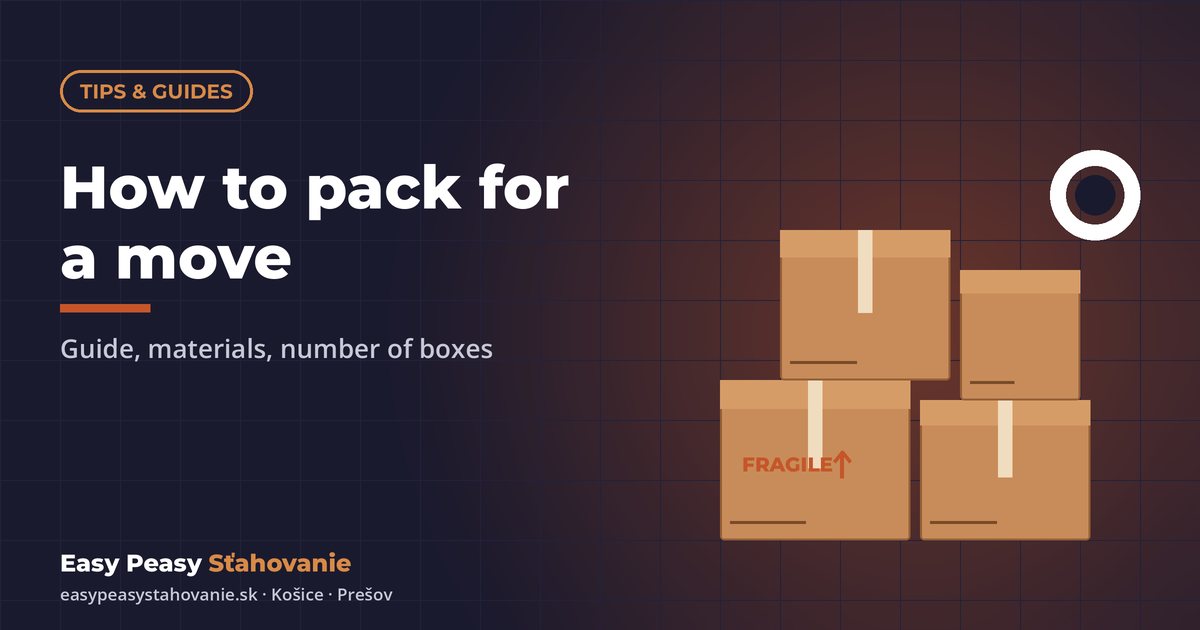
How to pack for a move: a mover's guide, materials and how many boxes you need
Good packing saves hours on moving day and keeps your things safe. A guide from professional movers: how many boxes you need, packing room by room, and when professional packing pays off.
Contents
Packing is the part of moving most people do themselves – and the part that decides how long moving day takes and whether everything arrives in one piece. A well-packed home loads quickly, stacks safely and unpacks logically. A badly packed one means split boxes, broken plates and hours of extra work. This guide shows you how to pack for a move the way professional movers do it, how many boxes you'll need, where to get materials in Slovakia and when it's worth paying someone else to do it.
How many boxes do you need?
It's the first question everyone asks. The number depends on the size of your home, but also on how many books, kitchen items and toys you own. As a guide (Slovak flats are counted by rooms – a "2‑room flat" is a living room plus one bedroom):
| Home size | Small boxes | Medium boxes | Large boxes | Total |
|---|---|---|---|---|
| Studio (garsónka) | 8–10 | 8–10 | 2–5 | 15–25 |
| 1‑room flat | 10–15 | 12–15 | 3–5 | 25–35 |
| 2‑room flat | 15–20 | 15–25 | 5–8 | 35–50 |
| 3‑room flat | 20–30 | 25–30 | 8–10 | 50–70 |
| Family house | 30–45 | 40–60 | 10–15 | 80–120 |
Small boxes for books, dishes and tools; medium for clothes, toys and kitchen bits; large for duvets, pillows and light bulky things.
What packing materials to buy
Moving boxes, tape and bubble wrap are sold at DIY stores, larger supermarkets and online in Slovakia. Supermarkets will often give away sturdy fruit or drinks boxes for free – ideal for heavy items. For a two-room flat, plan on roughly:
| Material | Used for | Quantity for a 2‑room flat |
|---|---|---|
| Wide packing tape | Sealing tops and bottoms | 4–6 rolls |
| Bubble wrap | Glass, china, electronics, pictures | 1–2 rolls |
| Packing paper | Dishes, glasses, filling gaps | 3–5 kg |
| Stretch film | Drawers, doors, mattresses, upholstery | 1–2 rolls |
| Bags for clothes and bedding | Soft things that don't need a box | 10–15 |
| Markers and labels | Room and contents | 2–3 markers |
| Small zip bags | Screws and fittings from furniture | 10–20 |
Five golden rules of packing
- Heavy things in small boxes, light things in large ones. A large box full of books can't be carried safely and often splits. Stay around 20 kg.
- Fill boxes completely. Half-empty boxes crush when stacked. Fill gaps with paper, tea towels or towels.
- Tape the bottom in a cross. Double tape on the base is cheap insurance.
- One box, one room. Don't mix kitchen and bathroom – unpacking will be twice as fast.
- Label the top and the side. In a stack you can't see the top, so write the room and contents on the side too.
Packing room by room
Kitchen
The kitchen is the hardest room – lots of fragile and heavy things. Wrap plates individually and stand them on their edge, not flat; they cope with knocks much better that way. Stuff glasses with paper and pack them upside down. Nest pots inside each other and fill them with small items. Tape up spices and open liquids and put them in a bag. Pack the kitchen last and keep a first-night box with a pan, a couple of plates and cutlery.
Living room and electronics
Use original boxes for the TV and speakers if you kept them. If not, wrap the screen in a blanket or bubble wrap, reinforce the corners with cardboard and transport the TV upright. Photograph the cable connections before unplugging and keep the cables in a labelled bag. Books go into small boxes, lying flat or spine down.
Bedroom and wardrobe
Clothes on hangers can go straight into bags – pull a bin bag up over a bundle of hangers and tie it. Seasonal clothes go in bags or medium boxes. Wardrobes and tall chests must be empty; full, they're too heavy and can break. Low chests with light contents can stay filled if the drawers are secured with stretch film.
Bathroom
Close cosmetics and cleaning products, tape open bottles and put them in zip bags. Carry medicines yourself in the bag with your documents.
Children's room
Sort toys as you pack – the perfect chance to let go of what nobody plays with. Mark one box of favourite toys clearly and unpack it first; children settle faster in a new home.
A labelling system that saves hours
The combination that works best is colour plus number. Give each room a colour (kitchen red, bedroom blue) and each box a number. Stick a matching coloured sheet on each door in the new home – the movers take each box straight to the right room without asking. Keep a simple list on your phone: box number → contents. When you need the charger, you know it's in box 14. Mark fragile items FRAGILE (or the Slovak KREHKÉ) with an arrow pointing up, and load the first-night box last so it comes off first.
What not to pack
- Hazardous materials: flammables, gas canisters, chemicals, paint and thinners.
- Valuables and documents: jewellery, cash, passports, residence cards, contracts, backup drives – carry them yourself.
- Medication and chargers – you'll need them straight away.
- Open food and fridge contents – use them up or transport them in a cool bag.
- Plants – never in a closed box. Move them separately, ideally in your car.
Preparing furniture and large appliances
- Washing machine: disconnect the day before, drain the filter and fit the transit bolts if you have them – without them the drum can be damaged.
- Fridge and freezer: switch off at least 24 hours ahead, defrost, wipe dry and leave the door ajar. After the move let them stand for a few hours before switching on.
- Beds and tables: dismantle, put screws in a zip bag and tape it to the largest part. Photograph complicated furniture before taking it apart.
- Mattresses: wrap in stretch film or a mattress bag.
- Mirrors and pictures: tape the glass in an X, wrap in bubble wrap, protect the corners and transport upright.
More on dismantling in Furniture assembly and disassembly when moving.
When professional packing is worth it
If you're short on time, own a lot of fragile things or are moving a long way – abroad, for example – professional packing pays off. We charge €50/hour for two packers, plus €0.75/km outside the city. Materials are charged as used.
| Home | Estimated packing time | Labour (excl. materials) |
|---|---|---|
| 1–2‑room flat | 4–6 hours | €200–300 |
| 3‑room flat | 6–8 hours | €300–400 |
| Family house | 8–12 hours | €400–600 |
Indicative prices excl. VAT. A mix often works best – you pack books and clothes, we pack the kitchen and fragile items.
Unpacking order
Unpack the first-night box and bed first, then the bathroom, then the kitchen. Wardrobes and the children's room follow on day two; decorations last.
Summary
Good packing means fewer boxes, a faster move and nothing broken. Buy boxes in several sizes, keep heavy things in small boxes, fill every box, pack room by room and label everything. The full task list is in our moving checklist for Slovakia, and if you live in an apartment block, read our tips on moving in a panelák. If you'd rather hand the packing over, our English-speaking team packs a typical flat in a single working day.
Frequently asked questions
How many boxes do I need for a 2-room flat?
Usually 35–50 boxes of different sizes – roughly half small ones for books and dishes and half medium ones for clothes and small items.
How heavy should one box be?
No more than about 20 kg. Heavy things (books, dishes, tools) go in small boxes, light things (duvets, pillows, clothes) in large ones.
How do I pack a TV without its original box?
Wrap the screen in a blanket or bubble wrap, reinforce the corners with cardboard and transport it upright. Photograph the cable connections first.
How much does professional packing cost?
Packing and unpacking costs €50/hour for two packers, plus materials as used. A 1–2-room flat usually takes 4–6 hours.
Where can I buy moving boxes in Slovakia?
DIY stores, larger supermarkets and online shops sell them; supermarkets often give away sturdy boxes for free. You can also rent reusable EasyBoxes from us.
What shouldn't go in boxes?
Flammables, gas canisters, chemicals, open food, medication, valuables and important documents. We don't transport hazardous materials; carry valuables yourself.